Evie
Earth AbidesEvie is a survivor of the Great Disaster whose life in the community exposes the tension between care for a vulnerable person and the power to decide what her future should be. Found by Ezra as a young child, she is sheltered and gradually becomes more communicative, but remains substantially cognitively impaired. The community’s protective intentions eventually harden into a taboo concerning her relationships, and her closeness with Charlie brings that unspoken rule into open conflict.
Identity and Early Life
Ezra found Evie living alone in severe deprivation. She was opening cans for food and foraging for worms and snails, with no one caring for her. She must have been about five or six when the Great Disaster occurred, although the account does not establish how long she had been alone before Ezra found her. Her early survival is presented not as independence freely chosen but as the bare routine of a child left without support.
The adults cannot determine whether Evie had always had a cognitive disability or whether the shock and isolation of the disaster had caused or intensified her condition. She cowered and whimpered, knew only a few words, and smiled only occasionally, even when Ezra tried to comfort her. After the group treated her kindly over a long period, she began to speak more, but did not develop in the way the adults considered normal. The uncertainty about her condition remains unresolved; the evidence offers no diagnosis and does not give Evie a fuller account of her own experience.
Life in the Community
Evie grows up within the household and social world of the survivors. Molly keeps her well groomed, and as an adult she is described as blond and slender. Yet the community continues to regard her primarily through the limits it perceives in her understanding. At a later gathering, she watches whoever is speaking and can seem alert, but Ish assumes that she understands little or nothing. His judgment that she cannot serve as a foundation for the future is part of his broader assessment of the community’s capacity to preserve knowledge; it also shows how readily he measures a person by usefulness to a future he hopes to shape.
A moment of Evie’s own initiative complicates that bleak assessment. In the nineteenth year, she sees an unfamiliar animal, points excitedly, and cries out in a voice that does not quite form words. The animal is an elk, the first anyone in the community has seen in many years. The sighting leads the children to name that year for the elk. Evie does not identify the animal in words, but her excitement directs the others’ attention and gives the community an occasion to mark the return of wildlife to the region. In this episode, her gesture has a public consequence: it becomes part of the group’s shared memory and calendar.
Care, Assumptions, and Taboo
Ish later recognizes that he, Em, and Ezra helped create a powerful prohibition around Evie. They feared that she might have children with similar impairments who would require care, and the adults therefore made her effectively untouchable to the boys. The rule was not established as a formal law. Ish understands that the young men may not even have imagined crossing it, because the prohibition had become stronger than an explicit command. He identifies it as a taboo—an example of how a small community can turn a practical concern into a force governing conduct and imagination.
That protection is entangled with a harsh judgment of Evie’s life. Ish privately questions whether the community should have kept caring for her, and whether her life brought happiness to her or anyone else. His thoughts reveal the danger in treating dependence as proof that a person’s life has little value. The narrative does not confirm his assumption about Evie’s happiness, nor does it establish what she wants for her future. Instead, it shows how decisions about her are repeatedly made by others, under the language of care, responsibility, and the community’s survival.
Charlie and the Open Conflict
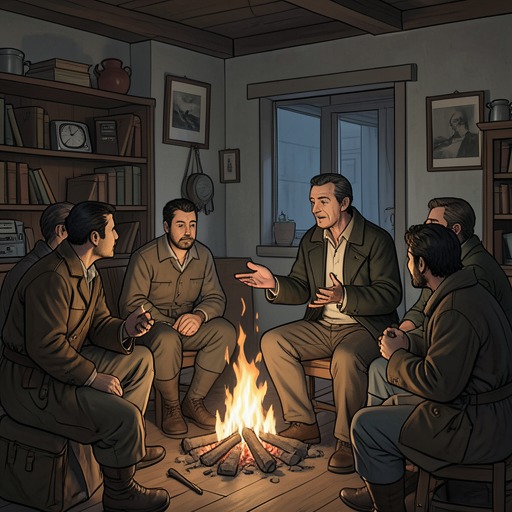
The taboo becomes visible when Ish finds Evie sitting close to Charlie and concentrating on him with unusual attentiveness. She seems drawn not simply to the meaning of his words but to Charlie himself. When Charlie makes her laugh and reaches toward her, she responds with uninhibited laughter; when Ish approaches, the group turns to him, looking for guidance. Charlie then draws Evie close, and she yields comfortably. Ish recognizes the gesture as open defiance of the authority behind the prohibition.
Ish explains that he wants to prevent children with substantial cognitive impairments from being born into the community. By arguing his case rather than simply issuing an order, however, he realizes that he has weakened the force of his command. The exchange exposes two competing kinds of authority: Ish’s claim to direct the group for its long-term welfare, and Charlie’s challenge to a rule that has never been enacted as formal law. Evie is central to the conflict, but the scene gives little direct access to her understanding of its stakes. Her visible responses—attention, laughter, and comfortable closeness—are distinct from the explanations Ish and Charlie supply for what should happen to her.
After the confrontation, Molly has to lock Evie in an upstairs room. Ish immediately recognizes the weakness of this measure: nothing would prevent her from jumping from a window. The practical problem intensifies the group’s dispute into a decision about how it will exercise power. Em frames the alternatives as banishment or death, and the adults prepare written ballots. The choice is thus made through a procedure involving the community, but the proposed outcomes underscore how little control Evie has over the deliberation about her own life.
Narrative Significance
Evie’s story repeatedly places an observable person beside the interpretations imposed on her. She survives alone, responds to sustained kindness, gradually speaks more, points out an elk, laughs with Charlie, and accepts his closeness. At the same time, others describe her as incapable, assess her contribution to the future, and create rules around her without establishing how she understands those rules. The contrast does not prove that she possesses capacities the narrative never shows; it does make the limits of the community’s knowledge consequential.
Her role also reveals how post-disaster care can become a form of authority. Ezra’s rescue and the group’s long-term protection give Evie a home, but the same community eventually treats her possible parenthood as a matter for collective control. The conflict over Charlie therefore concerns more than Ish’s command: it tests whether the survivors’ shared decisions protect a vulnerable member or subordinate her to a calculation about future generations. The evidence supplied here does not establish Evie’s eventual fate, and her thoughts remain largely unavailable. That unresolved perspective is central to her portrayal: she is both a person whose gestures affect the community and someone whose life is persistently interpreted, restricted, and debated by others.